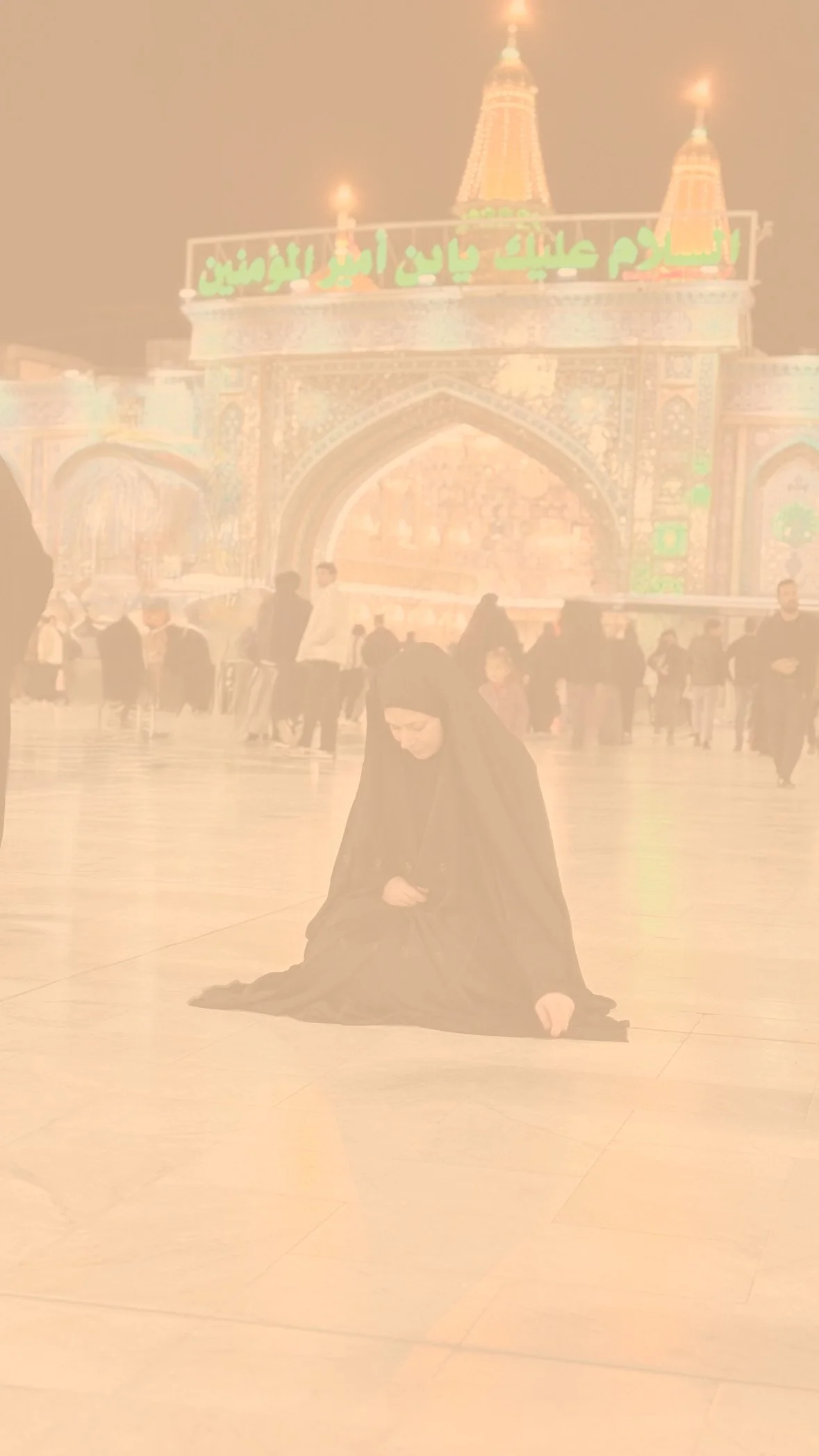
The Path of Hussain: What Karbala Taught Me About Healing
I know.
Many of you come to this blog looking for art.
Some of you come looking for art therapy.
Some of you come searching for healing, creativity, or ways to better understand yourself.
Today, I want to talk about something else.
I want to talk about love.
A love that has survived for nearly fourteen centuries.
A love that changed my life.
A love for a man named Hussain.
And before you stop reading because you think this is a religious post, stay with me.
Because I believe Hussain belongs to every human being who has ever been hurt by injustice, every human being who has ever felt silenced, and every human being who has ever struggled to remain loyal to their truth.
Who was Hussain?
Hussain ibn Ali was the grandson of Prophet Muhammad.
But if that is all you know about him, then you do not know Hussain.
To understand Hussain, you must understand the choice he made.
A corrupt ruler demanded his allegiance.
Hussain knew exactly what would happen if he refused.
He knew he would be killed.
He knew his companions would be killed.
He knew his family would suffer.
He knew his children would suffer.
He knew that he was walking toward death.
And still, he refused to surrender.
Not because he wanted power.
Not because he wanted a throne.
Not because he wanted a war.
He simply refused to legitimize oppression.
He refused to bow to a ruler who would humiliate people, exploit people, and use religion as a tool for power.
He chose truth over safety.
Dignity over survival.
Justice over comfort.
The older I get, the more I understand why his story moves me to tears.
As a child, I loved Hussain because my family loved Hussain.
As an adult, I love Hussain because I understand him.
I grew up in South Lebanon.
I grew up during occupation.
I grew up witnessing fear, uncertainty, war, and injustice.
I learned early that not every child gets to grow up feeling safe.
I learned that some people lose their homes.
Some lose their loved ones.
Some lose their voices.
And perhaps that is why Hussain resonates with me more today than ever before.
Because I am no longer seeing his story through the eyes of a child.
I am seeing it through the eyes of a woman who has lived.
A woman who has experienced loss.
A woman who has survived heartbreak.
A woman who has watched people suffer.
A woman who has spent years studying healing.
And I have come to realize something profound.
Hussain is not only for Shia Muslims.
Hussain belongs to the oppressed.
He belongs to those whose voices have been taken away.
He belongs to those who have been humiliated.
He belongs to those who refuse to surrender their dignity.
He belongs to every person who has ever stood before injustice and said:
"No."
There is a famous saying attributed to him:
"I see death as nothing but happiness, and life with oppressors as nothing but humiliation."
Think about that.
How many of us betray our values because we are afraid?
How many of us remain silent because speaking up might cost us something?
How many of us know the truth but choose comfort instead?
Hussain chose differently.
And that is why his story has survived.
Because truth has a way of surviving.
And perhaps this is where my work as an artist and future art therapist connects with Karbala.
People often ask me:
"What does art have to do with healing?"
Everything.
Because healing is not the absence of pain.
Healing is what happens when pain finds meaning.
One of the greatest lessons psychology teaches us is that human beings can survive almost anything when they can make meaning of their suffering.
Without meaning, pain becomes despair.
With meaning, pain becomes transformation.
And that is exactly what Karbala teaches us.
Karbala is not a story about death.
It is a story about meaning.
It is a story about purpose.
It is a story about remaining loyal to your truth even when the entire world pressures you to abandon it.
This is why art matters.
Stories matter.
Symbols matter.
When we create art inspired by Hussain, we are not simply painting events from history.
We are exploring courage.
We are exploring loyalty.
We are exploring resilience.
We are exploring sacrifice.
We are exploring what it means to be human.
The story becomes a mirror.
And in that mirror, we begin to see ourselves.
This year I had the honor of creating Stories of Muharram, an art experience for children.
Many people thought I was simply teaching history.
But that was never my goal.
My goal was to help children encounter values.
Because children may forget dates.
They may forget names.
But they will remember courage.
They will remember compassion.
They will remember standing up for what is right.
They will remember that one person can make a difference.
And those values will stay with them long after the paint dries.
This year, something else happened.
Hussain invited me to visit him.
I know some people reading this may not understand what I mean.
But those who have visited Karbala know exactly what I am talking about.
Some invitations are not sent through email.
Some invitations arrive in the heart.
For years, I wanted to visit.
For years, life got in the way.
And then this year, I found myself standing before his shrine.
I wish I had the words to describe it.
But I don't.
There is a love there that cannot be explained.
There is a peace there that cannot be photographed.
There is a feeling of being known.
Of being welcomed.
Of being seen.
You may think I sound irrational.
But Muslims believe that martyrs do not die.
The Quran tells us not to consider those who are killed in the path of God as dead. Rather, they are alive with their Lord, though we do not perceive it.
And perhaps that is why the connection feels so alive.
Perhaps that is why millions continue answering his call.
Perhaps that is why people leave Karbala different than they arrived.
I cannot prove any of this.
I can only tell you what I felt.
And what I felt was love.
A love so profound that it makes you want to become a better person.
A love that makes you want to tell the truth.
A love that makes you want to protect the vulnerable.
A love that makes you ask yourself difficult questions.
Am I loyal to truth?
Am I loyal to justice?
Am I loyal to God?
If I am not loyal to the values Hussain died for, then what exactly am I loyal to?
And then there is Zainab.
The woman history does not speak about enough.
The woman who witnessed the slaughter of her family.
The woman who endured unimaginable grief.
The woman who stood before the tyrant of her time after losing everything.
When he mocked her and asked what she thought of what God had done to her family, she replied:
"I saw nothing but beauty."
For years, I struggled to understand that sentence.
Beauty?
After all that loss?
After all that pain?
But the older I get, the more I understand.
She was not praising the tragedy.
She was praising God's wisdom.
She understood that this life is temporary.
She understood that suffering is not the end of the story.
She understood that surrendering to God's will does not remove pain.
It transforms it.
And maybe that is the deepest lesson of all.
Today, many of us are living through our own darkness.
Some are grieving.
Some are anxious.
Some are exhausted.
Some feel trapped.
Some feel hopeless.
It reminds me of Prophet Yunus in the darkness of the whale.
No way out.
No light.
No certainty.
And yet it was from the darkness that his prayer emerged.
Maybe healing works the same way.
Maybe our darkest moments are not proof that God has abandoned us.
Maybe they are invitations.
Invitations to return.
Invitations to surrender.
Invitations to discover strengths we never knew we had.
For me, that is the path of Hussain.
The path of remaining loyal to truth.
The path of choosing dignity over humiliation.
The path of transforming suffering into purpose.
The path of finding beauty even in hardship.
The path of standing up for others even when it costs you something.
The path of healing.
And if there is one thing I hope you take away from this article, it is this:
Whether you are Muslim or not.
Whether you know Hussain or not.
Whether you have ever heard of Karbala or not.
Ask yourself:
What truth am I being called to remain loyal to?
Because every healing journey begins there.